
Professor Dato’ Dr. Mohamad Fauzan Noordin received his Ph.D. from the University of Wales, U.K.1997; MBA from the Central Missouri State University, USA 1991; and B.Sc.(Computer Science) from the University of Missouri Kansas City, USA 1989. He is a professor of knowledge technology at Kulliyyah of Information and Communication Technology, International Islamic University Malaysia. His book entitled “ICT and Islam” has been used as a textbook in several universities. He was awarded the Darjah Setia Pangkuan Negeri Award (DSPN) Pulau Pinang, which carries the title Dato, by TYT Yang Di-Pertua Negeri Pulau Pinang on 23 July 2022.
Prof. Dato’ Dr. Mohamad Fauzan Noordin was the Advisor of Artificial Intelligence and Digitalization for the Minister of Higher Education. He has been invited as a speaker to talk about Artificial Intelligence (AI) in various universities in different countries such as Indonesia, South Korea, and Bangladesh. He is currently an Adjunct Professor at the Faculty of Artificial Intelligence, Universiti Teknologi Malaysia (UTM). He is one of Ahli Lembaga Pengarah Syarikat, Kolej Sains Perubatan Antarabangsa Pusrawi Sdn. Bhd. (Kolej Universiti Antarabangsa MAIWP (UCMI)) He was also appointed as Deputy Chairman of the National Education Advisory Council (NEAC) 2023-2025 by the Minister of Education.
He is the Director of the International Institution of Islamic Thought (IIIT) East and Southeast Asia and the Head of the ICT and Islamic Research Cluster. As the Director of IIIT, he has conducted the training for Future studies and Post-normal Time workshop organized by IIIT more than five times with more than 500 participants joining. Prof. Dato’ Dr. Mohamad Fauzan Noordin is also Chairman of the Cybersecurity Committee for Malaysia Crime Prevention Foundation (MCPF), chaired by the Deputy Prime Minister of Malaysia for three terms (2018-2020), (2021-2023) and (2024-2026). He is also a Member of the Penang State Government Syura Council, Penang Islamic Religious Council (2019 2022), and Vice President of WADAH Pencerdasan Umat Malaysia (2022-2024). He has been appointed as Deputy Chairman of the National Education Advisory Council (NEAC) 2023-2025 by the Minister of Education.
He was the Dean of the Center for Postgraduate Studies, International Islamic University Malaysia (2012-2013). In 2004, he was a Visiting Scholar at the University of Bahrain (2004-2005), Jazan University, KSA (2010-2011), and Islamic University of Maldives (2018). Besides, he was appointed and has been a member of the research panel for the Research Grant at the Ministry of Science Technology and Innovation since 2005, a panel member for the National Dakwah Policy of Malaysia (JAKIM), Adjunct Professor at the University Islam Sultan Sharif Ali, Brunei Darussalam (2017-2018). Adjunct Professor at Swinburne University Technology Sarawak Branch (2019-2020).
Prof. Dato’ Dr. Mohamad Fauzan was the Co-Founder of MyAis (Malaysian Association Information System). He specializes in Knowledge Technology, Management Information Systems (MIS), ICT and Islam, Social Networking, Cloud Computing, E Banking, Knowledge Management, and Wisdom in ICT. He was President of the Muslim Student Association (MSA), University of Missouri Kansas City, Missouri, USA, from 1987 to 1988.
Prof. Dato’ Dr. Mohamad Fauzan bin Noordin from Kulliyyah of Information and Communication Technology has been pioneered as the winner of ‘Cybersafe Professional of the Year in the Cyber Security Malaysia Awards, Conference & Exhibition (CSM-ACE) 2021. He was awarded the Gold Medal at the Malaysia Technology Expo 2016 (MTE) and received international recognition from Qatar Foundation Hamad Bin Khalifa University in 2019. This prominent leader is also a Bronze Award recipient for the Animation Category “Al-Kahfi” and a Promising Award for the Animation Category “Al-Biruni” at the Islamic World Film Festival 2013. In publishing, he has contributed more than 100 books, chapters, and articles in various local and international journals.
On 1st November 2024, Prof. Dato’ Dr. Mohamad Fauzan bin Noordin has been appointed as the Deputy Rector (Student Development and Community Engagement), International Islamic University Malaysia.
Artificial Intelligence (AI) extends beyond technological advancement; it represents a profound moral and spiritual challenge for humanity. As societies progress toward the vision of the MADANI Civilization, we are called to reflect on whether our engagement with AI embodies SyukurSyukur (gratitude) or Kufr (ingratitude) toward the divine trust of knowledge and innovation. Guided by the principles of sustainability, compassion, justice, and shared prosperity, the MADANI framework provides an ethical foundation for aligning technological progress with moral and spiritual consciousness. One of the key objectives of AI within the MADANI Civilization is to mould individuals with good moral character, ensuring that technological advancement nurtures virtue and humanity rather than mere efficiency.
This keynote introduces the concept of Heartware—the moral and spiritual dimension that complements AI’s hardware and software. Heartware advocates for the integration of ethical reasoning, emotional intelligence, and spiritual awareness into the design, development, and application of AI systems. By embedding empathy, accountability, and moral responsibility into innovation, Heartware ensures that technological progress serves humanity rather than undermines it. Drawing on examples from governance, education, and socio-economic development, this discussion illustrates how Heartware-driven AI can advance the ideal of rahmatan lil ‘alamin (mercy to all creation), positioning technology as an instrument of collective well-being and human flourishing.
Ultimately, the aspiration for AI within a MADANI Civilization is not merely to create intelligent machines but to cultivate humans who think and act with hikmah (wisdom), compassion, and gratitude. In this context, technology becomes a reflection of moral integrity and shared responsibility—anchoring innovation within the ethical and spiritual essence of humanity.
Keywords: Artificial Intelligence, MADANI Civilization, Heartware, Syukur and Kufr, ethics, sustainability, moral character

Engineering Department, Group Technical Solutions
Project, Technology & Health, Safety, Security & Environment (PT&HSSE)
PETRONAS
Mohd Nazmi has started his career as Executive (Pipeline) under Transmission Operation Division (TOD) (now known as Gas Transportation & Regassification Division), PETRONAS Gas Berhad (PGB). He has since been delivering optimal engineering solutions for key pipeline projects and initiatives including his appointment as Principal (Pipeline Integrity)/Head of Pipeline, TOD-PGB in October 2008. Subsequently, he was appointed as Custodian (Pipeline Integrity) cum Group Technical Authority, GTS in August 2012; and later as Custodian/Head/GTA (Pipeline Engineering), GTS in August 2020.
Mohd Nazmi is instrumental in hands-on and diverse operations and project management in oil and gas industry in particular offshore and onshore pipelines. His focus on pipeline design and integrity management systems as well as key business performance improvements.
On the professional front, he’s Chairman of Malaysia’s ISO Standard Technical Committee 67 – Pipeline Transportation, Editorial Board of Pipeline Technology Journal, Advisory Committee of Pipeline Technology Conference and Deputy Leader of Study Group 3 of International Gas Union’s (IGU) Transmission Committee. He has been active delivering technical papers and thought leaders worldwide on various topics concerning pipeline integrity, operations and maintenance.
Mohd Nazmi graduated with BSc. in Petroleum Engineering from University of Wyoming, Wyoming, USA.
In an era defined by digital transformation and sustainability imperatives, PETRONAS has embarked on a bold journey to redefine operational excellence through artificial intelligence. This keynote explores how PETRONAS integrates AI across its energy value chain to drive efficiency, safety, and resilience. The session will unveil the strategic blueprint behind PETRONAS’ AI Centre of Excellence (AI CoE) — a hub that orchestrates enterprise-wide AI initiatives, from smart asset management to autonomous operations. Attendees will gain insights into flagship programs such as STELLAR, ARIES, and Engineering Wizard, which capture tacit knowledge and transform it into actionable intelligence for real-time decision-making.
Beyond technology, PETRONAS’ approach emphasizes governance, ethics, and human capital. The AI CoE fosters a culture of responsible innovation, ensuring that AI solutions align with safety, compliance, and sustainability goals. This keynote is not just a story of digital tools — it is a narrative of transformation, collaboration, and leadership. It invites industry peers to explore how AI can be a catalyst for operational excellence and a cornerstone for a sustainable energy future.

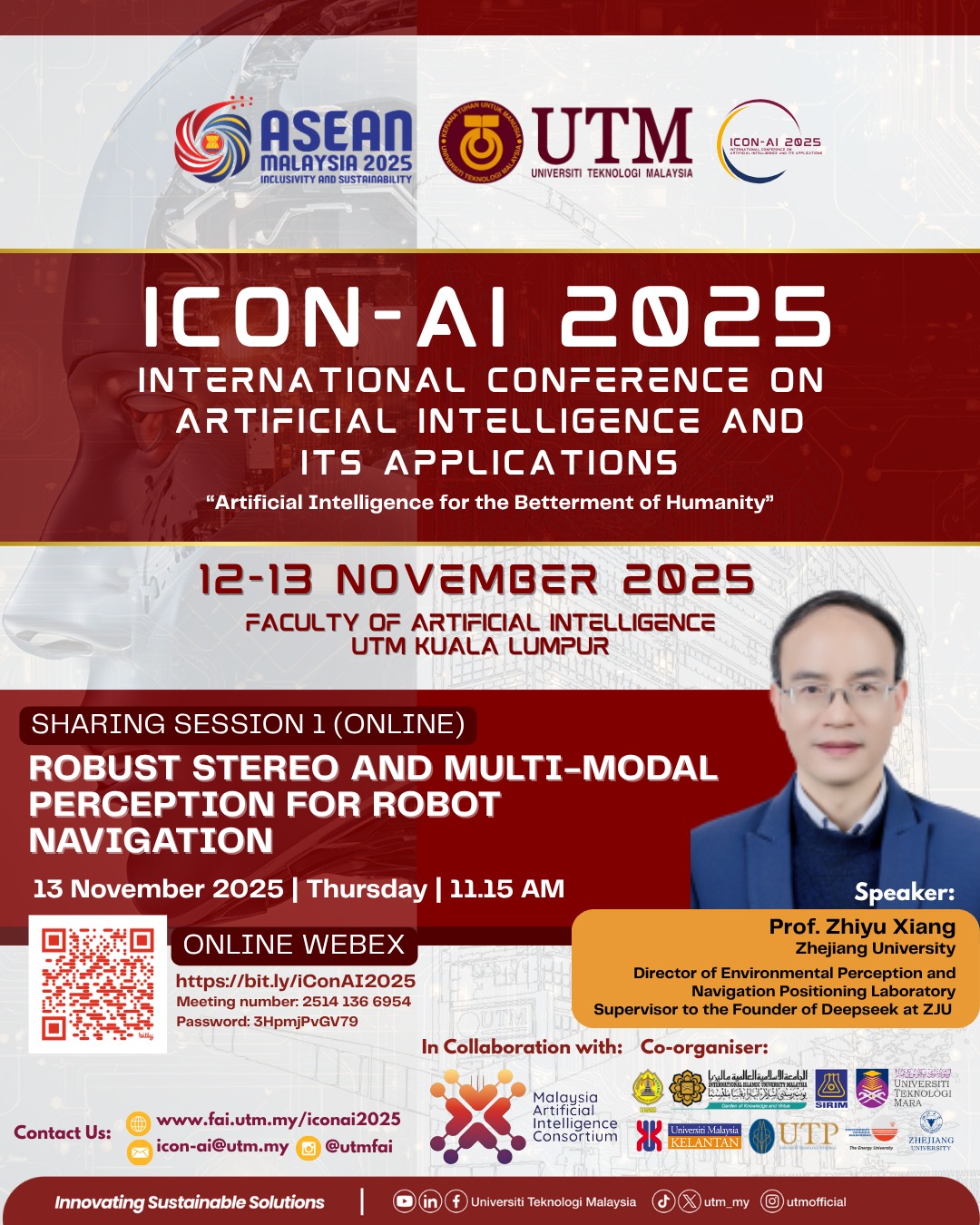
Zhiyu Xiang Received his Ph.D degree in 2002 from Zhejiang University. He was the Postdoctorial fellow in Aveiro University (Portugal) during 2002-2003, and the research fellow in The Ohio State University (USA) during 2003-2004, respectively. He is now a full Professor in Zhejiang University and vice director of the Institute of Information and Communication of Zhejiang University. As the project coordinator, he is conducting or has been conducted several research projects including 4 from National Science Foundation of China(NSFC). He also leads the Laboratory of Machine Vision and Navigation in ISEE department. His Reserach interestes include computer vision, multi-sensor perception and localization for robots. He has Published more than 50 papers in some refereed journals and Proceeedings.
Reliable 3D environmental perception capability is a fundamental safety prerequisite for robots and autonomous driving systems. The performance of existing stereo vision technologies is often significantly affected by factors such as changes in ambient lighting and low-texture scenarios, resulting in poor environmental generalization of stereo matching algorithms. Meanwhile, 3D object detection also faces the challenge of low adaptability under adverse weather conditions like rain and fog. This talk presents our research efforts aimed at enhancing the reliability of robot perception. By conducting reasonable multimodal modeling on the ground truth of stereo disparity networks, we can train high-performance stereo matching algorithms. Furthermore, integrating the outputs of multiple distinct stereo matching networks can substantially improve the environmental generalization ability of the network. For boosting the reliability of 3D object perception, we propose a 3D object detection algorithm that fuses 4D millimeter-wave radar data and image information. Through effective network design, this algorithm can fully leverage the complementary advantages of millimeter-wave radar and images, thereby significantly enhancing detection performance.

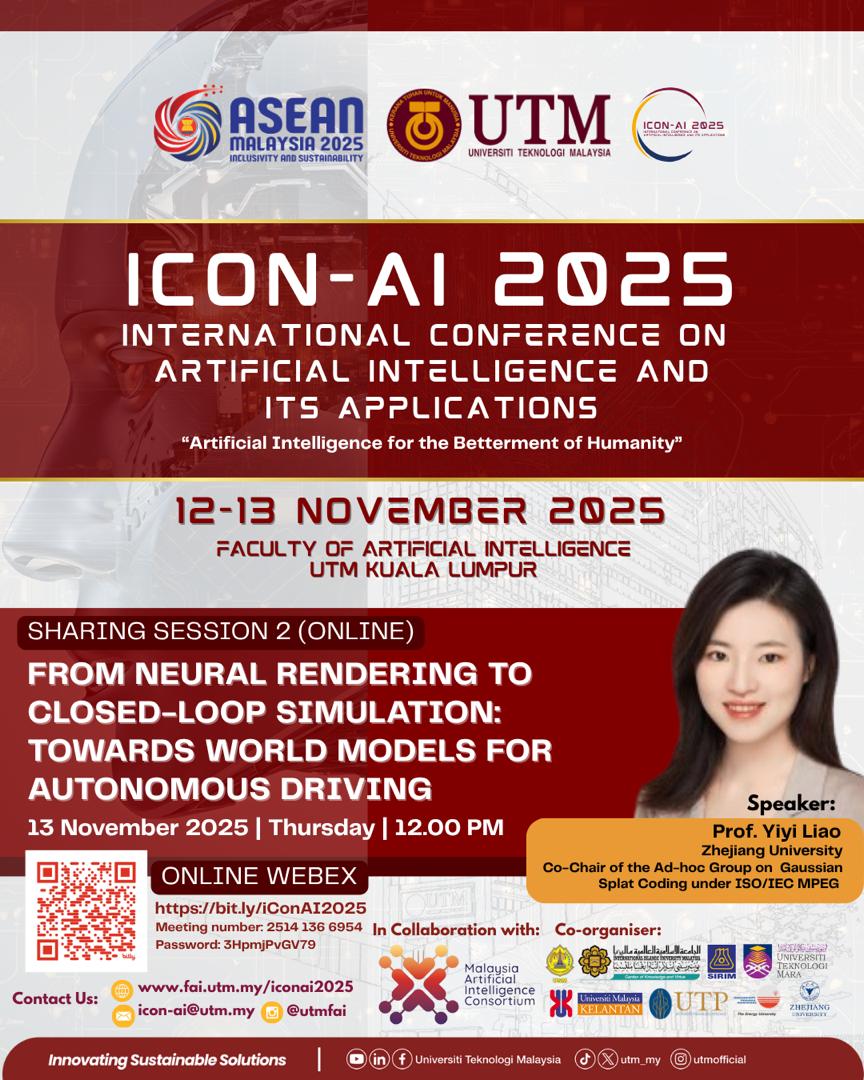
Yiyi Liao is an Assistant Professor at Zhejiang University. She received her Ph.D. from Zhejiang University and subsequently conducted postdoctoral research at the Max Planck Institute for Intelligent Systems. Her research focuses on 3D computer vision and immersive media, with particular interests in 3D scene reconstruction, generation, and compression. She has served as a Program Chair for 3DV 2025 and as an Area Chair for conferences including CVPR and NeurIPS. She is also a Co-Chair of the Ad-hoc Group on Gaussian Splat Coding under ISO/IEC MPEG.
Realistic and controllable simulation platforms are essential for closed-loop testing and long-tail safety evaluation in autonomous driving. Manually designed simulators offer strong controllability but are costly and often differ from real-world scenarios. Recent advances in neural rendering enable photorealistic scene reconstruction, though controllability and acquisition costs remain challenges. This talk will present methods for reconstructing and generating photorealistic, controllable world models for autonomous driving, and introduce HUGSIM, an open-source platform for training and evaluating driving algorithms in a closed-loop simulation environment.