Welcome to ICON-AI 2026
Advancing AI. Connecting Ideas.
The 2nd International Conference on Artificial Intelligence and Its Applications (ICON-AI 2026), organised by the Faculty of Artificial Intelligence, Universiti Teknologi Malaysia (UTM), brings together researchers, academics, industry professionals, and practitioners to share the latest advances in AI research and real-world applications.
Artificial Intelligence for a Sustainable Future
Explore emerging ideas through paper presentations, poster sessions, workshops, and exhibitions. From presenting research to demonstrating AI-driven solutions, ICON-AI 2026 offers opportunities to exchange knowledge, engage with experts, and build meaningful collaborations.
Explore the ICON-AI 2026 Programme
View the updated programme tentative and technical session schedule for 12–13 November 2026. Check the timings, venues and presentation details to plan your participation.
Co-located with ICDSAI 2026
Two Conferences. One Connected Community.
ICON-AI 2026 will be co-located with the 4th International Conference on Data Science and Artificial Intelligence (ICDSAI 2026), creating a broader international platform for the AI and data science communities.
This collaboration opens up opportunities for interdisciplinary discussions, knowledge sharing, research dissemination, and connections across academia and industry.
Explore ICDSAI 2026 ↗Join us in shaping the future of artificial intelligence.
There’s Still Time to Join ICON-AI 2026
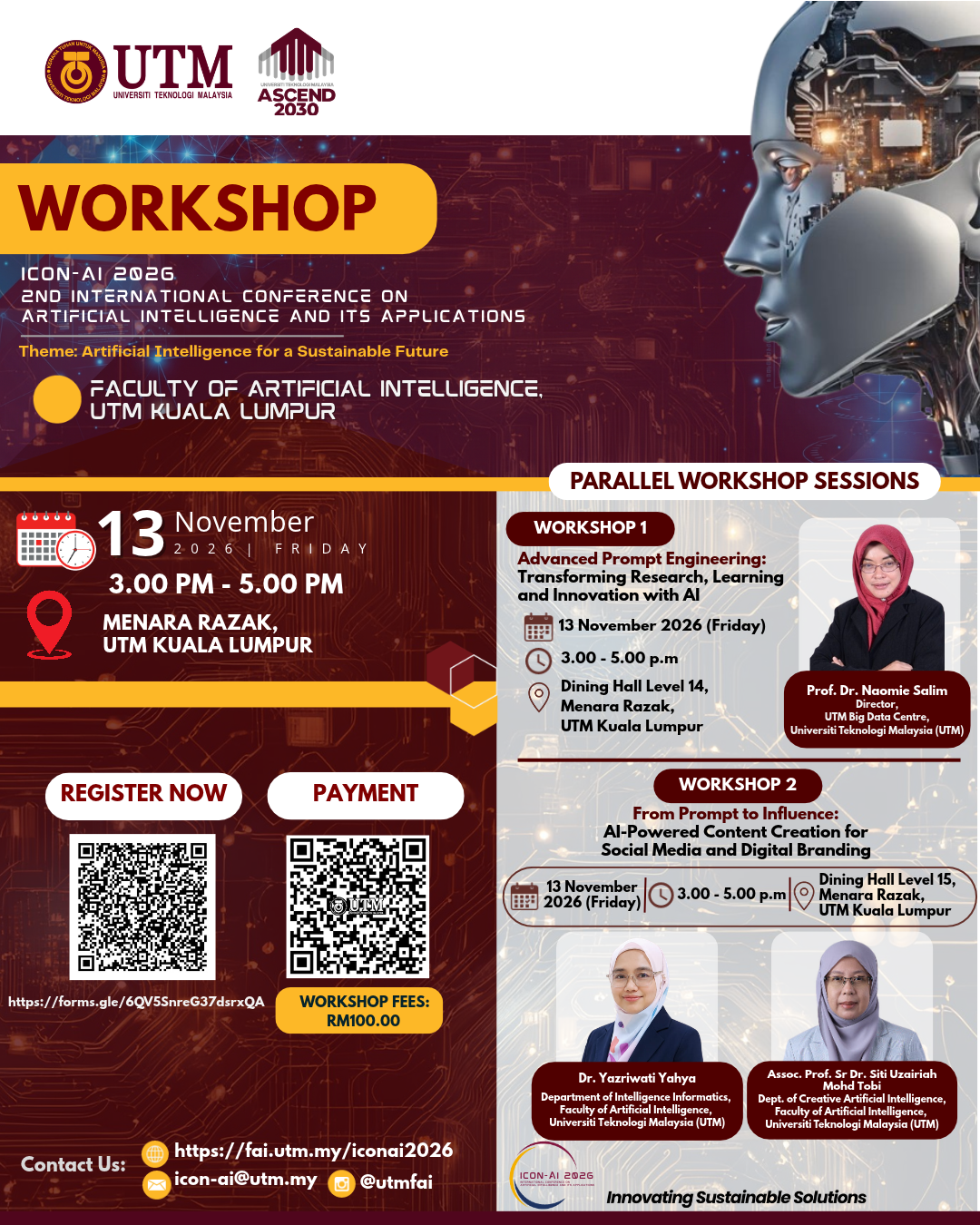
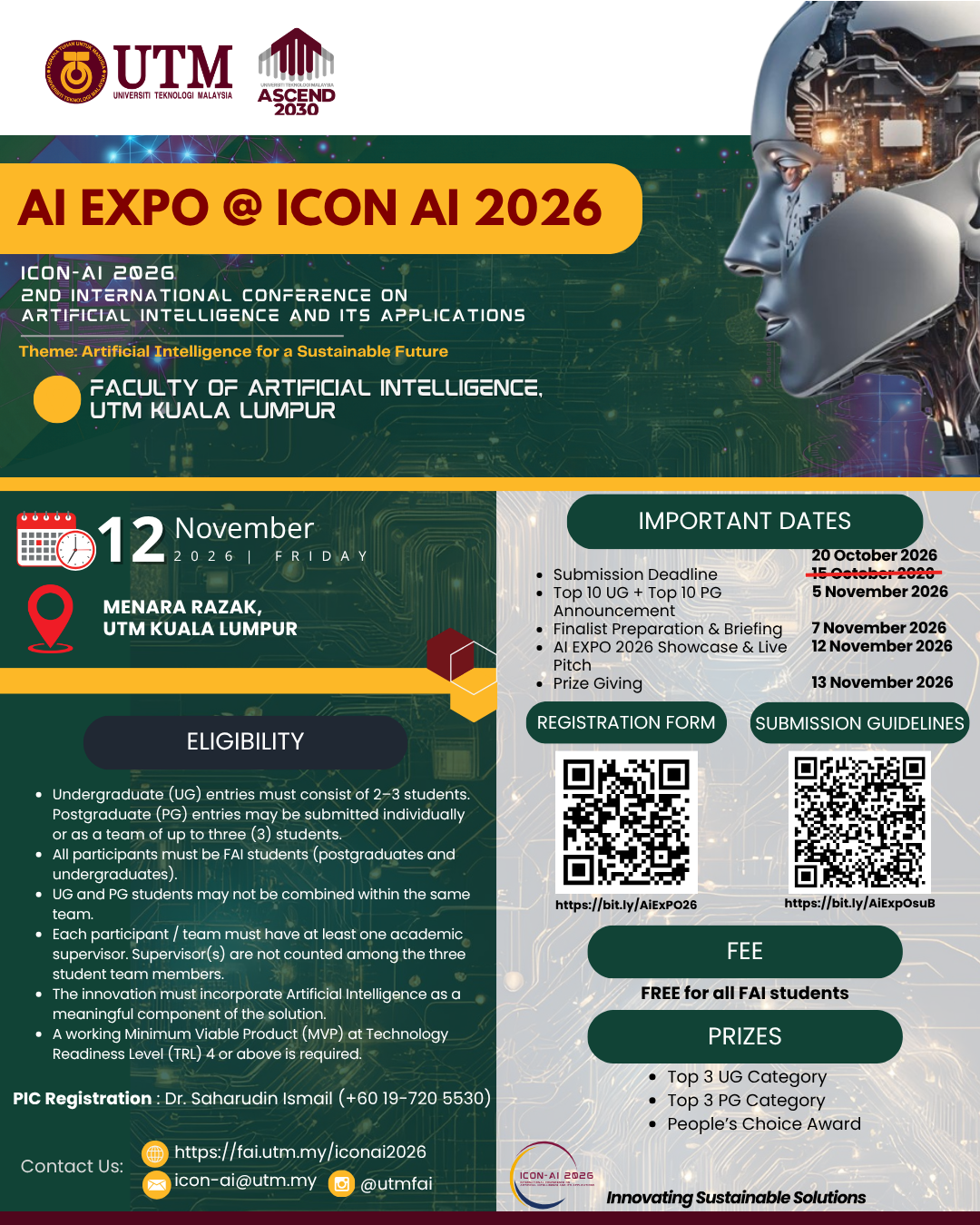
Explore the workshops, conference and AI Expo. Choose your programme below and register to join us.
ICON-AI 2026
KEYNOTE SPEAKER ABSTRACT
12 November 2026
9:20am – 10:10am
Dewan Azman Hashim
Prof. Ir. Dr. Chan Chee Seng
Can Visual AI Recognise Everything and Still Miss the Action?
Read Abstract
A vision model can identify the visible entities in a scene while failing to represent the event. A person may be drinking from a cup, pouring into it, washing it or passing it to someone else. The entities remain largely unchanged, yet the action, geometry, and contact differ. An image can also appear photorealistic while depicting an interaction that is physically or functionally implausible. Evaluations centred on appearance may not expose such failures.
This talk examines a research proposition. Interaction should become a central unit of visual intelligence. Human-object interaction offers a structured way to connect actors, actions, objects, spatial layout, contact and affordance across images, videos and 3D environments. Collaborative work on controllable generation, interaction editing, unified modelling and video-guided 3D affordance grounding illustrates what this representation enables. Its failures also reveal the limits of current approaches.
The broader challenge concerns interaction reasoning. Progress requires representations that transfer across tasks and modalities, together with evaluations of physical and functional consistency. It also requires evidence that can separate relational reasoning from convincing imitation. The talk, therefore, asks a simple but demanding question. Can visual AI move from recognising what is present to representing what is actually happening?
12 November 2026
1:30pm – 2:20pm
Dewan Seminar
Prof. Dr. Rob van Nieuwpoort
Sustainable AI-based Code Generation and Optimization
Read Abstract
Modern large-scale applications and instruments generate and process vast quantities of data and require large amounts of compute resources. To reach the needed efficiency and scalability, many applications exploit AI accelerators, such as the tensor cores in recent GPUs or neuromorphic hardware. We have ported many applications to such hardware and will show that large performance and energy efficiency gains are feasible. However, porting applications to such different and quickly evolving hardware platforms is very challenging.
Recent Large Language Models (LLMs) may be able to solve this problem, since they can produce and optimize complex code. In this talk we explore how AI-driven approaches can assist developers in evaluating and optimizing their code, including porting to hardware accelerators. We are committed to sustainable solutions and want to achieve these improvements without increasing the energy budget. This also implies that we need to make the optimization process itself energy efficient. This poses a challenge, since LLMs are energy intensive. We therefore use Small Language Models (SLMs) instead to limit environmental impact.
We extend the SLMs in two ways to improve code generation quality and performance. First, we use a multi-sampling generation strategy and demonstrate that this can match or surpass larger single-generation models with fewer computational resources. Second, we use agentic AI that feeds feedback from static and dynamic analysis tools (e.g., compilers, linters, profilers, etc.) back into the SLMs, which leads to consistent improvements. Our approach is generic and can also use Retrieval Augmented Generation (RAG).
As a motivating example, we use the LOFAR radio telescope. This instrument is currently being upgraded, increasing the sky area observed, while simultaneously processing more data faster. However, this increases the (already challenging) computational requirements 40-fold. This upgrade thus critically depends on rigorous performance optimization of the large existing software stack and widespread adoption of accelerators.
13 November 2026
9:00am – 9:50am
Dewan Seminar
Dr. Ayu Purwarianti
Trustworthy Agentic AI
Read Abstract
Large Language Model (LLM) technology has advanced rapidly, demonstrating strong performance in both discriminative tasks, such as classification and prediction, and generative tasks. Recent advances in LLM reasoning capabilities have accelerated the emergence of Agentic AI, enabling the automation of complex tasks through the coordination of multiple AI agents. These capabilities offer significant opportunities to enhance productivity, as tasks that previously required substantial human intervention, such as research, data analysis, and decision execution, can increasingly be performed end-to-end by AI systems.
However, the autonomy of Agentic AI introduces greater risks compared to the use of standalone LLMs. Unlike conventional LLM applications, whose outputs are primarily text-based, Agentic AI systems can perform real-world actions, such as sending emails, accessing external systems, and executing various operations. Consequently, errors or unintended behaviors may lead to more significant consequences. These risks highlight the importance of developing Trustworthy Agentic AI, where AI systems are not only capable and productive but also reliable, safe, secure, and accountable, with appropriate human oversight.
Achieving Trustworthy Agentic AI requires comprehensive AI governance to identify, assess, and mitigate potential risks. Governance for Agentic AI is considerably more complex than governance for standalone LLMs, as it must address not only the behavior of individual models but also the interactions among multiple agents and their autonomous actions. Furthermore, AI governance must be integrated throughout every stage of the Agentic AI lifecycle, from use case planning and system development to deployment, operation, and eventual system retirement.
Given the higher risks associated with autonomous AI systems, AI governance is no longer merely a best practice but an essential requirement for achieving Trustworthy Agentic AI. By incorporating risk management, accountability, and appropriate human oversight throughout the Agentic AI lifecycle, organizations can harness the productivity benefits of Agentic AI while ensuring that these systems remain trustworthy and responsibly governed.
13 November 2026
2:30pm – 3:20pm
Dewan Seminar
Assoc. Prof. Dr. Jan N. Van Rijn
Automated Machine Learning: Past, Present and Future
Read Abstract
Automated Machine Learning (AutoML) is a relatively young research area aiming at making high-performance machine learning techniques accessible to a broad set of users. This is achieved by identifying all design choices in creating a machine-learning model and addressing them automatically to generate performance-optimised models. We provide an overview of the past and present, as well as future perspectives of AutoML, and showcase several success stories for various scientific domains.
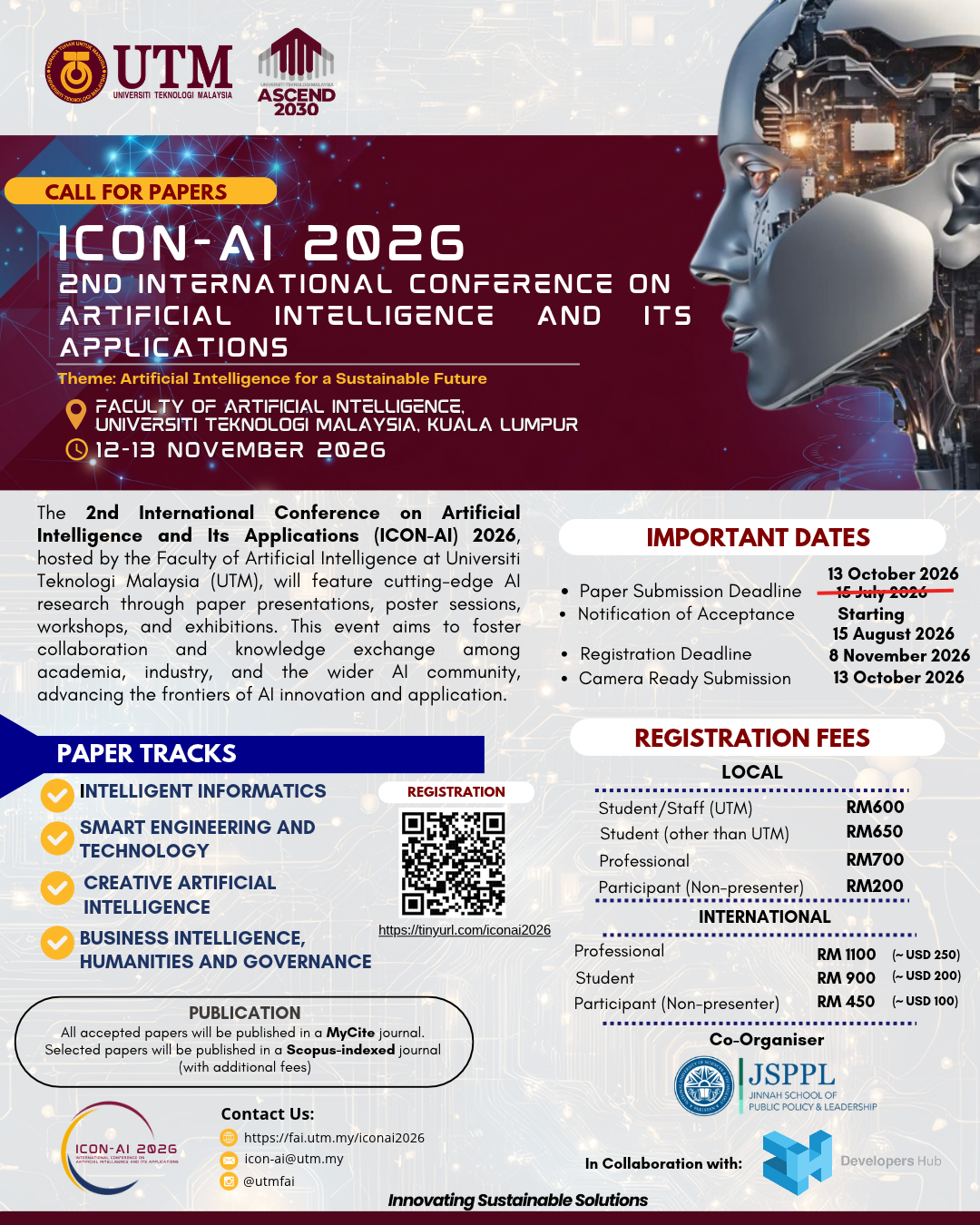
CALL FOR PAPERS
Plan Your Participation
Important Dates
Paper Tracks
Registration Fees
Local Participants
| Student / Staff (UTM) | RM 600 |
| Student (Other Institutions) | RM 650 |
| Professional | RM 700 |
| Participant (Non-presenter) | RM 200 |
International Participants
| Professional | RM 1,100 Approx. USD 250 |
| Student | RM 900 Approx. USD 200 |
| Participant (Non-presenter) | RM 450 Approx. USD 100 |
Publication Opportunities
All accepted papers will be published in a MyCite journal. Selected papers will be published in a Scopus-indexed journal, with additional fees.
Be Part of ICON-AI 2026
For enquiries: icon-ai@utm.my
